Powder and bulk solids handling starts with the material, not the machine: test how the powder flows, then pick storage, conveying and discharge equipment that suits that behaviour. The first decision is whether the material is free-flowing or cohesive.
This guide works as a decision path. Each section ties a handling problem to the equipment and the test that address it, and the guide on how to choose powder handling equipment takes final selection further.
What powder and bulk solids handling covers
Powder and bulk solids handling covers how dry particulate material is stored, discharged, conveyed, fed, mixed and protected between process steps. Industry guidance from INDPRO names three primary objectives: contamination prevention, flow optimization and safety assurance. These objectives can pull against each other, which is why the order of decisions matters. A choice that improves one, such as an enclosed transfer line for purity, still has to be checked against flow and safety.
The same guide groups typical challenges into dust control, flow issues, moisture sensitivity and combustible hazards. Flow issues are the most common reason a line stops. The named problems are bridging, rat-holing, segregation, flow rate fluctuations and flow stagnation. Food Processing adds that any of these situations can delay production, damage equipment or create safety hazards for employees. Handling is therefore a safety and quality discipline as well as a way of moving material.
The main equipment families
- Silo and bin hopper: these store material and decide how it leaves. Most flow trouble starts here, because the geometry either supports reliable discharge or does not.
- Pneumatic conveying and vacuum conveying: these move powder through pipelines using air pressure or vacuum, and suit transfers where the product must stay enclosed.
- Mechanical conveyors: screw conveyors and belt conveyors carry material without an air stream and are the main alternative to pipeline transfer.
- Bulk bag discharger and unloading stations: these empty large bags, small bags and drums into the process, usually with dust collection.
- Feeders, valves and batching: these meter material into a process at a controlled rate or weight.
- Sieves, blenders and separators: these protect product specification and purity once material is moving.
The sections below follow the order in which most projects have to decide: material behaviour first, then storage and discharge, then conveying, then the points where material enters and leaves the system.
First decision: what does the material do?
The flow properties of powders decide which equipment will work, so characterise the material before comparing machines. INDPRO states that particle size, bulk density and flowability drive equipment choice: bulk density affects storage and conveying capacity, and flowability influences equipment selection. A free-flowing granular product and a fine cohesive powder can need completely different hoppers, feeders and conveying methods, even when the throughput target is identical.
Criteria to settle before choosing equipment
- Particle size and distribution: coarse and fine fractions behave differently. Food Processing notes that variations in particle size cause a mixture to separate during distribution, a problem called segregation.
- Bulk density: it sets how much volume a given mass occupies, so it feeds directly into silo volume and conveying capacity.
- Flowability and cohesion: the key question is whether the powder will flow under gravity from a hopper or hold an arch across the outlet.
- Environment: humidity, temperature and particle size are material factors that processors must consider alongside the equipment flow pattern.
- Fragility: if breakage changes the product, gentle handling becomes a selection criterion rather than a nice-to-have.
- Combustibility: combustible dust brings dust collection and electrical and static-electricity controls into the design from the start.
Which tests produce usable design data
Shear cell testing is the route from a powder sample to hopper design numbers. Engineers at DDPS describe measuring bulk density across a range of consolidation stresses and plotting a flow function that shows how the cohesive nature of the material lessens under higher consolidation stresses. The practical point is that bulk density is not a single catalogue number. A powder sitting under the load of a full silo is not in the same state as a powder poured loosely into a container, so design values should come from tests at the relevant stress. The guide to powder flowability testing methods covers how those tests compare, and bulk density vs tapped density explains why different density measurements are not interchangeable.
Simple property checks still have a role. They help screen materials quickly and flag the ones that need full shear testing. They do not replace shear data when the job is sizing an outlet or choosing a hopper angle.
Second decision: storage and discharge
Silos and bin hoppers fail in predictable ways, and the fix is usually geometry matched to the material rather than a bolt-on device. Because a silo controls every downstream step, it is the best place to spend design effort. The guide to silo design for bulk solids develops the storage decisions in more depth.
Mass flow or funnel flow
The hopper flow pattern is the first storage choice, and it follows from how cohesive the material is. According to Food Processing, funnel-flow cones, which dispense material by gravity at a 45-degree slope, work best for free-flowing, non-degrading coarse particles. Mass-flow hoppers feature a slope of 60 degrees or greater and are designed for cohesive solids, fine powders and blends that segregate.
- Choose funnel flow when: the material is coarse, free-flowing and not prone to degrading, and the extra height of a steep hopper adds cost without benefit.
- Choose mass flow when: the powder is cohesive, fine or a blend that separates, because the whole contents move together and discharge is more uniform.
- Do not decide by habit: a hopper copied from a previous product can carry the wrong pattern. The article on mass flow vs funnel flow sets out the trade-offs in full.
Arching, bridging and ratholing
Arching and ratholing come from a mismatch between the material’s cohesive strength and the hopper geometry and outlet. Bridging, where material arches over the outlet, and ratholing, where only a channel above the outlet empties, both stop flow. The pairing of hopper pattern and material matters, but so does the outlet. Food Processing notes that bridging could still occur if the outlet is not sized properly for the material, so a mass-flow slope alone is not a guarantee.
DDPS describes the outlet diameter target as large enough to prevent arching, enable mass flow and ensure collapse in the event of a rathole. That is a design requirement drawn from shear cell data, not a rule of thumb. Operators facing a stuck hopper should read the guide on hopper flow problems in bulk solids, and the page on how to prevent bridging in hopper covers prevention at the design stage.
Flow aids and bin dischargers
Flow aids help an existing hopper but cannot rescue a poor geometry. INDPRO lists vibration, agitation, air fluidization and bin activators as methods to break bridges and prevent ratholing. Air fluidization works by introducing a controlled flow of air into the hopper or silo so the powder fluidizes. Treat these as a second line of defence, and compare the options in the overview of bin discharger types.
Third decision: mechanical or pneumatic conveying
The choice between mechanical and pneumatic conveying depends on what the material tolerates and whether the product must stay enclosed. Neither method is better in general. INDPRO describes pneumatic powder transfer as using air pressure or vacuum to move fine powders through pipelines, and the pipeline format suits dust-free operation. Mechanical conveyors move material without an air stream and are the natural comparison when a pipeline is not essential.
Questions that separate the two
- How important is enclosure? A pipeline keeps powder contained and supports dust-free operation, which favours pneumatic conveying for fine, dusty or hazardous powders.
- How fragile is the particle? Any conveying method that damages particles will affect the product. Check this before committing to a high-velocity air stream.
- What are the particle size, bulk density and flowability? These drive both equipment choice and conveying capacity, so use tested values rather than supplier typicals.
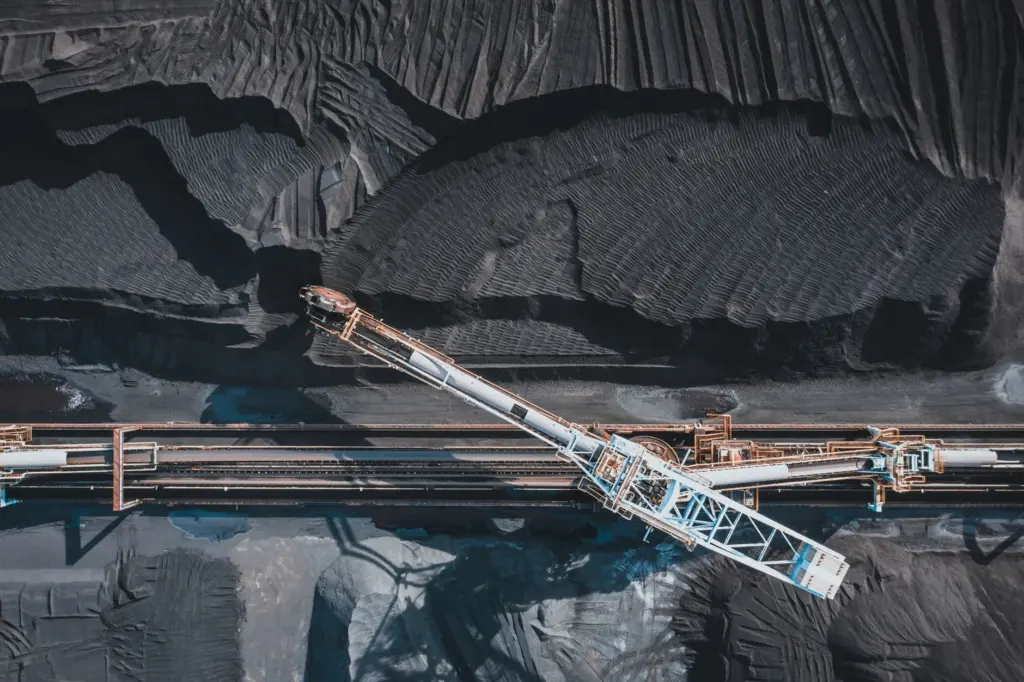
- Is the material open to handle in the plant? Coarse, robust bulk material can suit an open mechanical conveyor, such as a belt conveyor, where dust is manageable.
Pneumatic and vacuum systems
Pneumatic conveying pushes or pulls material through a pipeline, and vacuum conveying is the version that draws it with negative pressure. Equipment makers such as DDPS list vacuum conveying alongside bag emptying, bulk bag unloading and drum unloading as separate product categories, which shows how often these are specified as distinct but connected steps. For design principles, see pneumatic conveying system design. For the main design split, dilute phase vs dense phase pneumatic conveying sets out how the two modes differ.
Line blockages are the characteristic failure of pipeline conveying. Food Processing lists blockages with bridging and ratholing as problems that delay production and damage equipment. The article on pneumatic conveying line blockage causes deals with the causes and the checks that prevent them.
Screw and belt conveyors
Mechanical conveyors are worth choosing when the material is robust and the transfer route is simple. A screw conveyor suits short transfers and metering; the explanation of how does a screw conveyor work covers its operating principle. For long horizontal or inclined runs of coarse material, see belt conveyor for bulk materials. If the material degrades, the mechanical route needs the same scrutiny as an air stream.
Moving fragile or friable powders
Fragile powders need handling chosen around breakage, because degradation changes the product itself. Food Processing states that degradation can affect the flavor, texture and nutritional value of the final product. That makes breakage a quality and compliance concern, not only a cosmetic one, and it should be a criterion from the first equipment comparison.
The approach has several parts.
- Reduce the number of transfers: every conveying step, valve and drop is a chance for particles to break, so fewer handoffs are generally better for friable material.
- Choose gentle mixing: INDPRO describes paddle mixers that gently move materials with wide, flat paddles to maintain the integrity of fragile particles. Ribbon blenders use helical blades that move powders in opposite directions to achieve homogeneity, so the two are chosen for different priorities.
- Control conditions: powders can be sensitive to moisture absorption and temperature fluctuations, so handling that works on a dry day may not hold on a humid one.
- Trial the real product: test the actual material through the proposed route before committing, because generic equipment claims do not predict how a specific particle behaves.
Vacuum conveying is often considered for fragile material, but the choice should rest on trials with the product, not on the method name alone.
Unloading bulk bags, drums and smaller bags
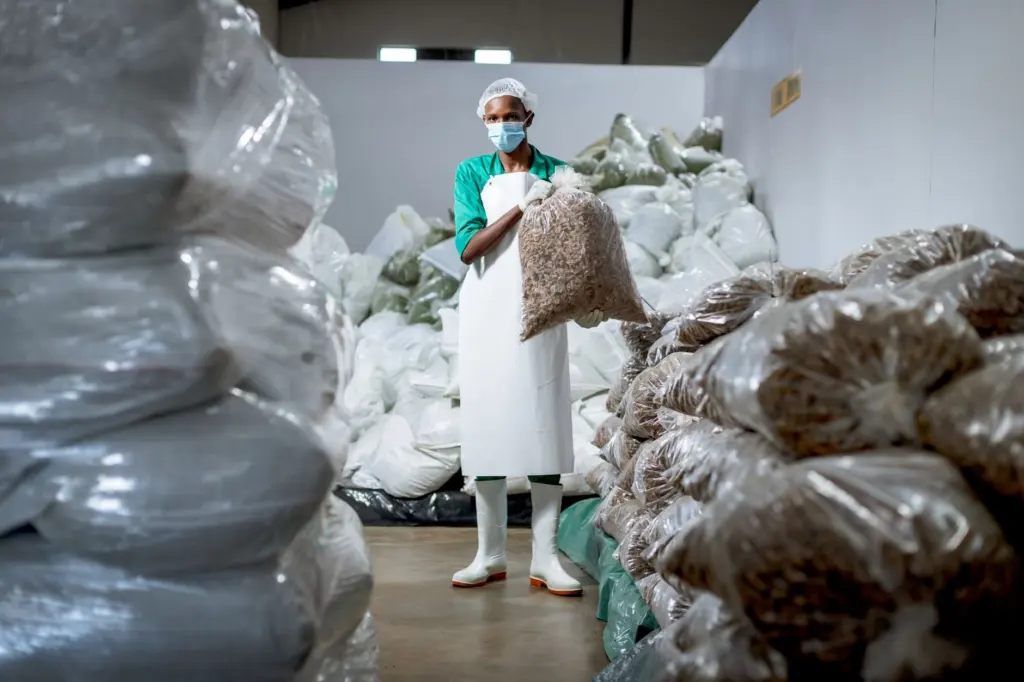
Bulk bag unloading is safest when the discharge is enclosed, connected to dust collection and designed for the material’s hazards. INDPRO describes material unloading stations used to transfer powders from small and big bags as well as drums, equipped with dust collection. A bulk bag discharger is the large-bag version of this idea. It sits above the receiving hopper or process so material falls directly from the bag.
Dust and ignition controls
Dust is both a health and an explosion concern, so unloading cannot be treated as a simple mechanical step. Food Processing notes that dust collection systems can minimize the buildup of combustible dust, and that special safety measures must be taken, including electrical and static-electricity controls. When the powder is combustible, the discharger, the dust collector and the grounding arrangements should be designed together. The guide to dust control at transfer points covers the transfer points around the unloading station.
Smaller bags and manual work
Manual sack handling is the other end of the range. It can suit low volumes, but it exposes operators to dust and creates uneven feeding, so it becomes harder to justify as throughput or hazard increases. Moving to an enclosed unloading station with dust collection is the usual step up.
Feeding, valves, weighing and batching
Feeders, valves and batching systems turn stored material into a controlled process input. They sit between the hopper and the rest of the plant, so poor hopper flow shows up here as unstable feed rates. INDPRO identifies flow rate fluctuations and flow stagnation among the flow challenges, which is the typical symptom a feeder reveals before an operator sees a blocked outlet.
- Choose a feeder after the hopper is right: a feeder cannot compensate for material that will not leave the hopper reliably. The overview of types of powder feeders compares the main options.
- Use weight-based feeding when rate accuracy matters: the article on how does a loss in weight feeder work explains the principle.
- Treat valves as part of the system: the explanation of how does a rotary valve work shows how they meter material and separate pressure zones in conveying lines.
- Design batching as a whole: weighing, feeding and discharge interact, and powder batching system design covers that integration.
Contamination, sizing and abrasive materials
Contamination control belongs inside the handling design, because the first stated objective of powder handling systems is contamination prevention, meaning product purity and prevention of cross-contamination. Enclosed transfer, dust collection and clean unloading all serve it. Separation equipment handles what enclosure cannot.
INDPRO lists vibratory sieves as a way to ensure powders meet exact particle size specifications by efficiently removing oversized particles. Place sieving where oversize material would damage downstream equipment or spoil the specification, rather than assuming the supplier’s grade is clean.
Abrasive materials change the equipment decision again, because wear affects maintenance and contamination from worn parts. The guide to handling abrasive bulk materials covers material and equipment choices for those duties.
Problem, equipment and test at a glance
The table below links common handling problems to the equipment that addresses them and the data to check first.
| Handling problem | Equipment that addresses it | Test or data to check first |
|---|---|---|
| Bridging and ratholing in a hopper | Correct outlet diameter, hopper angle and, where needed, vibration, agitation, air fluidization or a bin activator | Shear cell data and the flow function |
| Conveying capacity and storage volume | Silo or conveyor sized from tested density | Bulk density across consolidation stresses |
| Dust during transfer | Pneumatic pipeline; unloading station with dust collection | Particle size and bulk density of the powder |
| Breakage of fragile particles | Gentle mixing such as paddle mixers with wide, flat paddles | Trial with the actual product and its flowability |
| Oversize particles | Vibratory sieve | Particle size specification |
| Inhomogeneous blends | Ribbon blender with helical blades | Particle size variation that could cause separation |
These pairings draw on equipment guidance from INDPRO and hopper design practice described by DDPS.
Choosing where to start
Start with the symptom you already have, because it points to the section with the highest return.
- Material hangs up or flows erratically: begin with hopper geometry and test data, then consider flow aids.
- Dust, purity or operator exposure is the concern: begin with enclosed unloading and transfer.
- Product is breaking or changing: map each handling step the powder passes through and trial gentler options.
- A new line is being specified: characterise the powder first, then compare mechanical and pneumatic routes against the same criteria.
Frequently asked questions
Is bulk density a single fixed value for a powder?
No. DDPS describes measuring bulk density across a range of consolidation stresses, so the value changes with the load the powder is under. Use the figure that matches the stress in the silo or hopper being designed.
What does a flow-function graph tell a designer?
It shows how the cohesive nature of the material lessens under higher consolidation stresses. Designers use it with outlet and hopper geometry to judge whether the powder will arch or flow.
Can flow aids replace correct hopper design?
They are better treated as a supplement. DDPS says hopper design data can show whether flow aids may be required, for example because of spatial limitations, alongside outlet shape and hopper angle.
Why recheck a powder that flows well today?
INDPRO notes that powders can be sensitive to moisture absorption and temperature fluctuations. A powder that flows well under one set of plant conditions can behave differently when those conditions change.