| Density value | What it reflects | Planning use |
|---|---|---|
| Bulk density | Mass per unit volume of a loose, freely filled bed, counting pores and the voids between particles | Sizing hoppers, bins and packages that are filled by pouring or gravity |
| Tapped density | Mass divided by the settled volume once tapping no longer reduces the volume | Judging how far a powder can compact under vibration, transport or storage |
| Hausner ratio | Tapped density divided by the initial bulk density | Quick screen for cohesiveness and flowability, to be confirmed with flow tests |
| Particle (true) density | Mass of solid per unit volume, excluding pores and voids | Reference for porosity and void fraction, not for sizing storage |
Definitions and the Hausner ratio follow GranuTools’ comparison of standardized tapped density methods and Norlab’s overview of powder density.
Bulk density vs tapped density is a question of packing: bulk density describes a loosely filled bed, tapped density the same powder after tapping has settled it. Use bulk density for free-fill volumes and tapped density to judge compaction.
These values sit within the wider field of powder and bulk solids handling, where the same material can legitimately carry several density figures depending on how it has been handled.
Where each density value is used
A single powder does not have a single density that suits every design task. The right figure is the one that matches the state the powder is actually in at that point in the process.
Silo and hopper sizing
Bulk density is the mass per unit volume measured when powder is freely filled into a container, so it is the natural basis for working out how much a freely filled bin or silo holds. Tapped density describes a denser state of the same powder. Because the volume of a sample decreases during tapping, the same mass occupies less space once the bed has compacted. Sizing a vessel on the tapped figure when the powder arrives loosely would overstate the mass it holds. Sizing on the loose figure when the powder will be vibrated or stored for a long time can leave the vessel under-filled in practice.
Conveying and feeding
Any equipment that moves powder by volume delivers a different mass when the bed density changes. A feeder drawing from a hopper meets powder in a loose or a consolidated state depending on what has happened upstream, so the density you assume should reflect that state. Our guide to types of powder feeders covers how different devices meter material. The tapped-to-bulk comparison also gives an early warning: the ability of a sample to pack under taps is a measure of its cohesiveness, which links to how readily it flows.
Packaging
Packages are filled to a volume or a mass, and the two only agree if the powder is in the expected state. A powder filled loosely and then jolted during transport settles to a smaller volume, leaving more empty space in the pack. Fill-weight targets, container sizes and headspace are therefore best set from measurements taken on powder in the condition it will be in at filling, with the tapped value showing how much settling to expect afterwards.
Choosing the right figure
- Free-fill volumes: use bulk density when powder is poured or gravity-fed into a container and not disturbed.
- Vibrated or long-stored material: check tapped density, since the bed compacts and the volume falls.
- Flow concerns: compute the Hausner ratio from both measurements as a first screen, then move to dedicated tests such as those in powder flowability testing methods.
- Porosity questions: compare bulk density with particle density rather than with tapped density.
Why one powder has several density values
Bulk density considers the existing pores and the interparticular voids of a loose powder bed, according to Norlab. Particle density, also called true density, is the actual mass of solid matter per unit volume, so it leaves pores and voids out. Bulk density therefore sits below particle density, and the gap between them is the empty space in the bed.
That gap is the void fraction, and it is what ties the figures together. A bed with a larger void fraction has a lower bulk density for the same solid. Tapping removes part of that void space by letting particles rearrange, which is why the tapped value moves closer to the particle value than the loose one does, though it never reaches it while voids remain.

What drives the void space
Powder bulk density decreases with decreasing particle size, increasing particle asphericity and increasing surface roughness, as Sat Nano explains. Particle size distribution also plays a part. Fine, irregular, rough particles tend to hold more space between them, so two powders of the same material can differ in bulk density without differing in particle density at all.
Measuring bulk and tapped density
The calculation itself is a division. For bulk density, divide the mass of powder by the volume it occupies after free filling; the result is usually expressed in g/cm3. For tapped density, the same source describes putting powder into a container, vibrating it until the volume stops decreasing, then dividing the weight of the powder by that final volume.

Standard methods
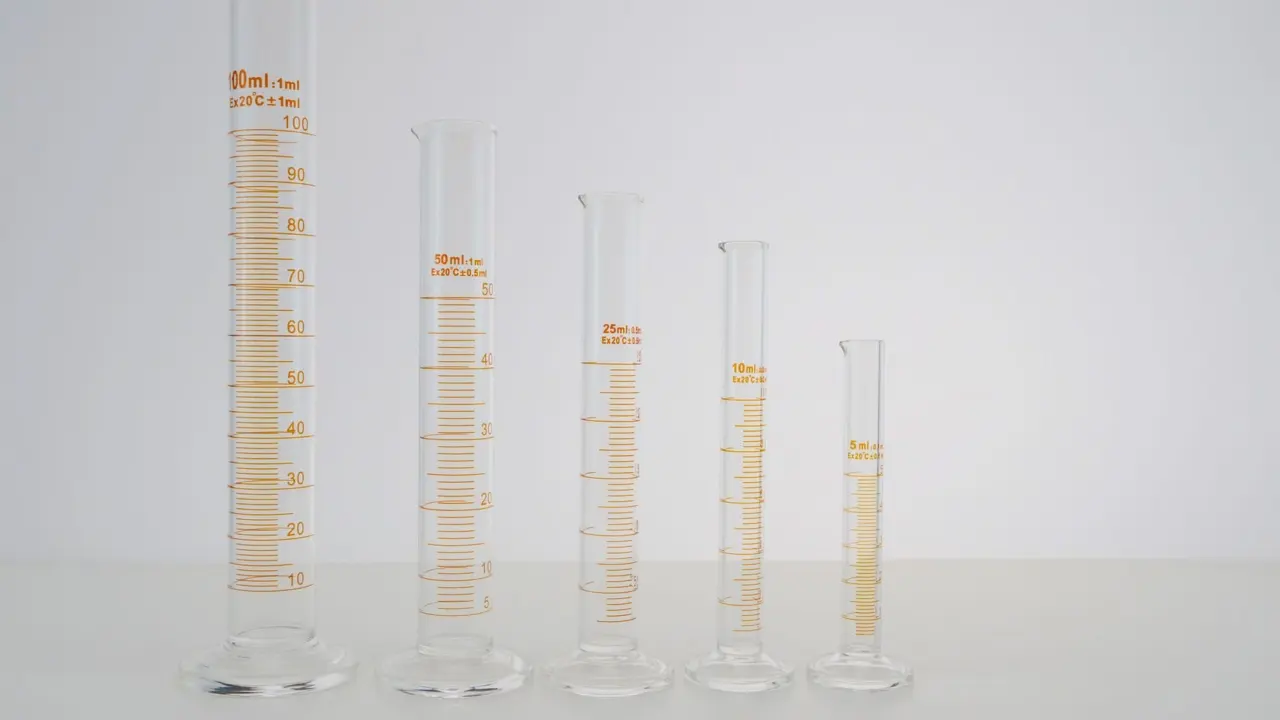
Tapped density measurement has been standardized by pharmacopeias and other bodies, including USP, Ph. Eur, ISO and ASTM, as GranuTools notes. USP 616 and ASTM B527 both require the operator to read the powder height visually, typically in a graduated cylinder, and the standardized measurement uses a large sample of about 100 g. USP 616 also asks the operator to carefully level the powder without compacting it after pouring, because disturbing the bed at this stage would change the starting volume and with it the bulk density.
The Hausner ratio
The Hausner ratio is Hr = ρ(n)/ρ(0), where ρ(0) is the initial bulk density and ρ(n) is the tapped density obtained after n taps. A ratio that rises well above that of a comparable free-flowing material signals a powder that packs readily under taps and is therefore more cohesive. Treat it as a screening figure, since the visual reading in the standard methods introduces operator judgement.

Particle density and void fraction
Particle density cannot be read from a poured or tapped bed, because both include voids. It describes the solid itself. Comparing it with bulk density shows how much of the loose bed is solid and how much is empty, which is the porosity of the bed.
This comparison is useful for diagnosis. If two lots of the same material have the same particle density but different bulk densities, the difference lies in packing, meaning size, shape or surface roughness, and not in composition. If the tapped value is far above the bulk value, the loose bed holds a lot of recoverable void space, and any process that vibrates or compresses the powder will release it.
Handling and storage effects
Bulk density is not a fixed property of a powder because the loose bed is only one of the packings it can take. The bulk volume before tapping shows how compressible the material is, and anything that mimics tapping in plant, such as vibration, drops during filling or the weight of material above, pushes the bed towards its tapped state.
For that reason, record how a bulk density figure was obtained. A value from a gently poured sample, a scooped sample and a stored sample are different measurements. Because fine, rough or irregular particles pack loosely, powders with those traits are the ones most likely to show a large change between filling and storage.
Bulk density of common powders
Common powders such as flour, cement and salt differ in bulk density because their particle sizes, shapes and surface roughness differ, and not only because the solids differ in density. A coarse crystalline material like salt usually packs differently from a fine, irregular one, so a typical value quoted for a product name is only a starting point.

Supplier data sheets and engineering handbooks are the usual places to find reference values. Use them for early estimates, then measure the actual lot under the same filling and tapping conditions you plan to use, because size distribution and handling history can move the result.
Frequently asked questions
What is the difference between bulk density and tapped density?
Bulk density is measured on a loose, freely filled bed. Tapped density is measured after the powder has been vibrated until its volume stops decreasing, so it is the denser of the two.
How do you calculate bulk density of a powder?
Divide the mass of the powder by the volume it occupies after free filling, expressed in g/cm3. The tapped figure uses the same division with the final settled volume.
How does particle density differ from bulk density?
Particle density counts only the solid, excluding pores and voids. Bulk density includes the voids between particles, so it is lower.
Which test standards cover tapped density?
USP 616 and ASTM B527 are both named for tapped density measurement, and both rely on a visual reading of the powder height.