Fluid bed granulation builds granules by spraying binder solution onto powder suspended in fluidizing air. When granules turn lumpy or the bed collapses, spray rate is usually outrunning drying. Slow the spray or raise drying capacity before changing anything else.
This guide sits within the wider set of powder processing unit operations. It is organised around the problems operators meet: setting the spray against the drying, choosing a spray position, and diagnosing poor granules.
How the process works
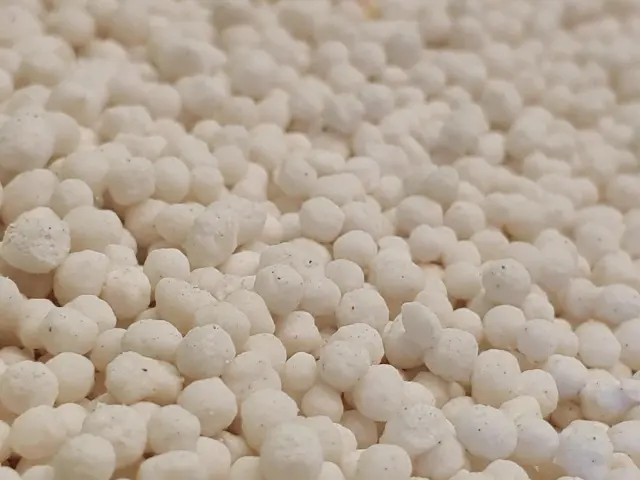
A fluid bed granulator granulates powder with a fluidizing air technique. Warm air lifts the powder into a moving bed, a nozzle delivers binder solution, and wetted particles stick together into larger granules as the air dries them. Peer-reviewed work on fluid bed wet granulation describes the technique in exactly these terms.
The equipment is mature. GEA states that it has supplied fluid bed processors for blending, granulating and related duties for more than 50 years, and notes that the machines are known as fluid bed Multi-Processors in the USA. Its FlexStream design uses one product container for granulating, drying and coating, so the batch does not move between vessels.
Fluid bed granulation is not the only route to granules. For a comparison with the alternatives, see wet granulation vs dry granulation.
Balancing binder spray rate against drying
Granule growth is a contest between wetting and drying. The binder solution adds liquid to the bed, and the fluidizing air removes it. Granule size follows whichever side is winning.
Fluidizing air flow was treated as a covariate. Spray rate and air flow therefore have to be considered together. Changing one while the other drifts makes cause and effect hard to read.
- Bed looks wet, clumps or stalls. The spray is adding liquid faster than the air removes it. Reduce the spray rate first, and only then look at air flow and nozzle atomization.
- Granules stay fine after the planned liquid is added. Binder delivery is likely too slow or too dilute for the bed. Raise the spray rate in small steps and watch the bed for the first signs of wetness.
- Results swing between batches. Hold the fluidizing air flow steady and change one spray variable at a time, so the effect of each change is visible.
Universal values for inlet air temperature and spray rate do not transfer between products. The right window depends on the powder, the binder solution and the machine. A two-level full-factorial design, as used in a fluid bed granulation study of granule size distribution, is a sound way to map that window with few runs.
Knowing when to stop spraying
In the peer-reviewed comparison, the granulation end point in the fluid bed was determined manually. That judgement depends on the operator and can drift between batches. The same pharmaceutical technology study measured granule size distribution in-line with spatial-filter velocimetry on a laboratory-scale top-spray granulator. Where in-line size measurement is available, it gives a more objective stopping signal than appearance alone.
Choosing top spray or bottom spray
Spray position decides where the binder meets the particles, and it should be chosen by trial with the actual formulation.
- Top spray. The nozzle sits above the bed and sprays down onto the fluidized powder. This is the configuration used in the laboratory-scale top-spray granulator in the size-monitoring study, so it has the clearest documented link to granule size control. It suits general granulation work where the bed can be watched and the spray adjusted from above.
- Bottom spray. The nozzle sits at the distributor plate and sprays upward, in the same direction as the air. Because spray and drying air share a path, the balance between liquid and evaporation shifts compared with top spray. Treat it as a different process, not a swap.
Do not carry spray rate settings from one position to the other. Re-establish the spray-versus-drying balance, using the approach above, whenever the nozzle moves.
Troubleshooting granule size and quality
Most failures trace back to the same balance, plus formulation effects. In the peer-reviewed comparison, filler type had a more pronounced effect on granule properties in the fluid bed than in the rotary processor. A formulation change can therefore cause a problem that no setting adjusts away.
| Symptom | Likely cause | First adjustment |
|---|---|---|
| Oversized lumps or a sluggish, wet bed | Liquid addition outpacing drying | Reduce spray rate; check that fluidizing air flow has not fallen |
| Excess fines, small granules | Too little binder reaching the bed, or spray too slow | Increase spray rate in small steps; confirm nozzle delivery |
| Rising resistance in the exhaust, loss of fluidization | Fine or sticky material loading the filters | Inspect and clean filters; review whether the bed is running too wet or too dusty |
| Batch-to-batch size drift | Uncontrolled air flow or manual end point judgement | Fix air flow; consider in-line size measurement |
| Granules behave differently after a filler change | Filler type effect on granule properties | Re-run a small designed trial before scaling |
The levers in this table, liquid addition rate, fluidizing air flow and filler type, are the ones examined in the fluid bed versus rotary processor study.
When troubleshooting, check the exhaust side along with the spray. Filter condition affects how much air the bed actually receives, which feeds straight back into the spray-versus-drying balance.
Advantages and disadvantages
Fluid bed granulation is a good fit when one machine should granulate and dry, and when granules go on to tableting. It is a weaker fit for difficult powders.
Where it performs well
- Several operations in one vessel. A single product container can handle granulating, drying and coating, which removes transfers between vessels.
- Useful compression behaviour. In the peer-reviewed comparison, fluid bed granules had slightly better compressional properties than rotary processor granules. That matters for the downstream powder compaction process.
- Range of scales. GEA describes systems from small capacity units designed for R&D up to industrial size plants.
Where it struggles
- Density and flow. The rotary processor gave denser granules with better flow properties in the same comparison.
- Cohesive powders. The authors suggest rotary processing as an alternative to fluidizing air granulation, especially for cohesive powders with poor flow properties.
- Formulation sensitivity. Filler type had a stronger effect on granule properties in the fluid bed, so formulation changes need fresh trials.
- Operator-dependent end point. Manual end point judgement adds variability unless in-line measurement replaces it.
Scaling from laboratory to production
Laboratory trials define the spray-versus-drying window cheaply. Production then confirms it. The size-monitoring study used a laboratory-scale top-spray granulator for this reason, and the factorial design let it study several process influences on granule size distribution at once.

Keep the same spray position at both scales, and carry over the relationships found in development, such as how granule size responds to spray rate at fixed air flow, rather than absolute settings. Where in-line size measurement was used in development, keep it in production so the end point stays comparable.
Frequently asked questions
| Question | Answer |
|---|---|
| Is there a standard binder spray rate? | No single value applies. The right rate depends on the powder, the binder solution, the air flow and the machine. Find it with a small designed trial and hold air flow steady while varying spray rate. |
| Can in-line measurement replace manual end point judgement? | It can support it. Spatial-filter velocimetry has been used to measure granule size distribution in-line during granulation, whereas the fluid bed end point in the peer-reviewed comparison was judged manually. |
| When should a rotary processor be considered instead? | For cohesive powders with poor flow properties, or where denser granules with better flow are the priority. |
| Is a fluid bed Multi-Processor the same as a fluid bed granulator? | GEA says its fluid bed processors are known as fluid bed Multi-Processors in the USA. The same machine type can granulate, dry and coat. |