| Decision point | Effect | Planning use |
|---|---|---|
| No liquid binder or drying step | The procedure is shorter than wet granulation because binder solution preparation and drying are not required. | Choose the dry route when the formulation is moisture- or heat-sensitive. |
| Roll force, expressed in kN per cm of roller width | Roll pressure, roll speed and feed rate together set ribbon density, a key quality attribute. | Specify force per unit of roller width and control ribbon density as a quality attribute. |
| Fines fraction | High amounts of fines remain and product yield is lower than with wet granulation. | Design a fines recycle loop from the start instead of treating fines as waste. |
| Tablet tensile strength | Tablets made from roll-compacted granules often show inferior tensile strength compared with wet granulation or direct compaction. | Test tablet strength early in formulation work. |
The effects above draw on the Pharmaceutical Technology review of the pros and cons of roll compaction and the equipment maker Senieer’s roller compactor process explanation.
What is roller compaction? It is a unit operation in dry granulation: a roller compactor presses powder into a strip or sheet of hard flakes, called ribbon, and milling then turns the ribbon into granules.
Dry granulation runs as mixing, roll compaction and milling. Roller compaction is one of the powder processing unit operations that decide whether a fine, difficult powder can be handled as a granule, and the ribbon is the control point for the whole route.
What the dry route changes in practice
The main consequence of roller compaction is what it leaves out. Pharmaceutical Technology notes that dry granulation methods suit moisture- and heat-sensitive compounds because no liquid or drying steps are required. Wet routes such as the high shear granulation process need a binder solution and a drying step, and the dry route avoids both. That shortens the procedure and removes the moisture and heat exposure that a sensitive formulation could not tolerate.
The trade is that the product is made by force alone, so the ribbon has to carry everything a binder would otherwise provide. That shapes every decision that follows.
Where the dry route pays off
- Sensitive formulations. When water or heat would damage the material, removing the liquid and drying steps is the strongest reason to choose roller compaction.
- Shorter process. There is no binder solution to prepare and no dryer to run, so the line is simpler than a wet granulation line.
- Poorly flowing powders. Substances with poor flowability and compaction behaviour can be handled this way, and Pharmaceutical Technology names acetaminophen and ibuprofen as examples.
Where it costs you
- Fines and yield. High amounts of fines remain and yield is lower than with wet granulation, so recycling capacity belongs in the original design.
- Tablet strength. Tablets made by roll compaction often show inferior tensile strength compared with wet granulation or direct compaction. A formulation that must produce very hard tablets deserves an early trial before the equipment is committed.
- Pressure sensitivity. The route depends on high pressure, which limits it for some active ingredients, as the next section explains.
Materials that suit dry granulation
Roller compaction suits materials that cannot take water or heat and can take pressure. Pharmaceutical Technology describes roll compaction as highly suitable for hygroscopic materials such as dry herbal extract, and as workable for poorly flowing, poorly compacting substances such as acetaminophen and ibuprofen. The common thread is a formulation where adding liquid is a problem rather than a convenience.
The limit is pressure. A review in Nutraceutical Business Review states that roller compaction is not a suitable option if high pressure results in physical or chemical changes to the API. For a pressure-sensitive active, the answer is to choose another granulation route rather than to compact more gently and hope for the same ribbon.
A practical screening order follows from this. Ask first whether the material is moisture- or heat-sensitive, which favours the dry route. Then ask whether high pressure alters it, which rules the route out. Only after both answers is it worth tuning settings.
How the ribbon forms between the rolls
A screw feeder delivers powder to the rolls, and the rolls squeeze it into ribbon. According to a review in the Research and Reviews journals, the screw feeder carries material to the rollers and somewhat de-aerates it. Feeding is therefore not just conveying: it conditions the powder before compaction and sets how much material reaches the nip.
The same review describes slip, nip and release zones between the rolls. In the nip region, also called the compaction zone, the material is trapped between the rollers and compacted. Senieer describes the result as a strip or sheet of hard flakes.
Roll surface
Roll surface is a design choice rather than a detail. The review notes that flat rollers are suitable for powders that tend to stick or cling to the roll surface. A powder that builds up on the rolls is a reason to look at the surface before changing force or speed.
Roll force, gap and speed
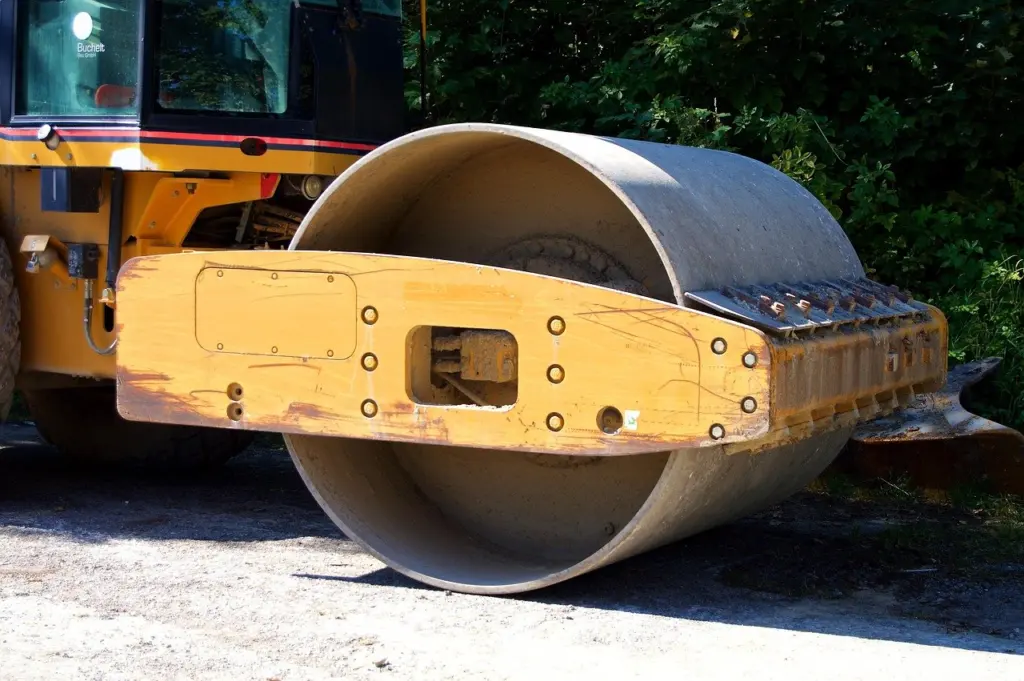
Ribbon quality is set by how hard, how fast and how much the machine compacts. Pharmaceutical Technology names the density of ribbons, together with flowability and compressibility, among the important product qualities, and links ribbon density to roll pressure, roll speed and feed rate. Treat ribbon density as the quantity to hold steady, and the three settings as the means of doing so.
Force
Senieer states that the applied force is expressed in kN/cm, the force per centimetre of the width of the roller. Quoting force per unit of width makes a setting meaningful for the roll in use, whereas a bare total force does not say how it is spread across the roller.
Gap
Gap behaviour depends on the machine type. On a floating-gap compactor, the force applied to the powder remains constant. The choice between a fixed and a floating gap is therefore a choice about what the machine holds constant: with a floating gap it is the force on the powder. Record which one a trial used before comparing results.
Speed and feed
Roll speed and feed rate act together on the density of the ribbon. A change to either should be treated as a change to ribbon density and checked as such, rather than adjusted in isolation. No single setting suits every formulation, so the working values are best established by trial for each material and then recorded.
From ribbon to granules
Milling converts the ribbon into usable granules without any liquid or drying step. The Nutraceutical Business Review article explains that the ribbon is milled into granules and blended with extragranular excipients. The hard flakes from the rolls are not the product; the granules after milling and blending are.
Senieer describes a pelletizing device used to crush the hard flakes into the desired particle size. This is ordinary size reduction applied to a dense, brittle feed, and the general options are covered in how to reduce particle size of powder.
Because the mill sees the ribbon rather than the original powder, the ribbon properties carry through. A ribbon with unstable density will mill into granules with unstable properties, which is why the settings in the previous section matter downstream.
Fines and recycling
Fines are the main cost of the dry route, and they are returned to the rolls rather than discarded. Pharmaceutical Technology notes that high amounts of fines remain and less product yield is obtained versus wet granulation. The review in the Research and Reviews journals describes the recovery: the finer granulated material from a roller compactor is pneumatically fractionated and recirculated to the rolls to be compacted again.
The same review adds that the speed of the flake crusher is an important parameter to optimise because it may affect the ratio of granules to fines. That makes crusher speed the first adjustment to examine when fines are excessive, ahead of enlarging the recycle loop. Recycling raises yield, but a loop that is constantly overloaded with fines points to a milling setting that needs attention.
Frequently asked questions
Can vacuum improve ribbon quality?
It can. Nutraceutical Business Review reports that applying a vacuum can give stronger and more uniform ribbons by reducing the disruption caused by air.
Why does scale-up focus on ribbon porosity?
The aim is that when ribbons made on a larger machine are milled, they have the same porosity and particle size distribution as before. Matching the ribbon is how the granules are kept consistent between scales.
How much does the mill screen matter?
A great deal. The size of the screen used during milling is described as one of the most important processing parameters, because it controls the granules that come out of the ribbon.